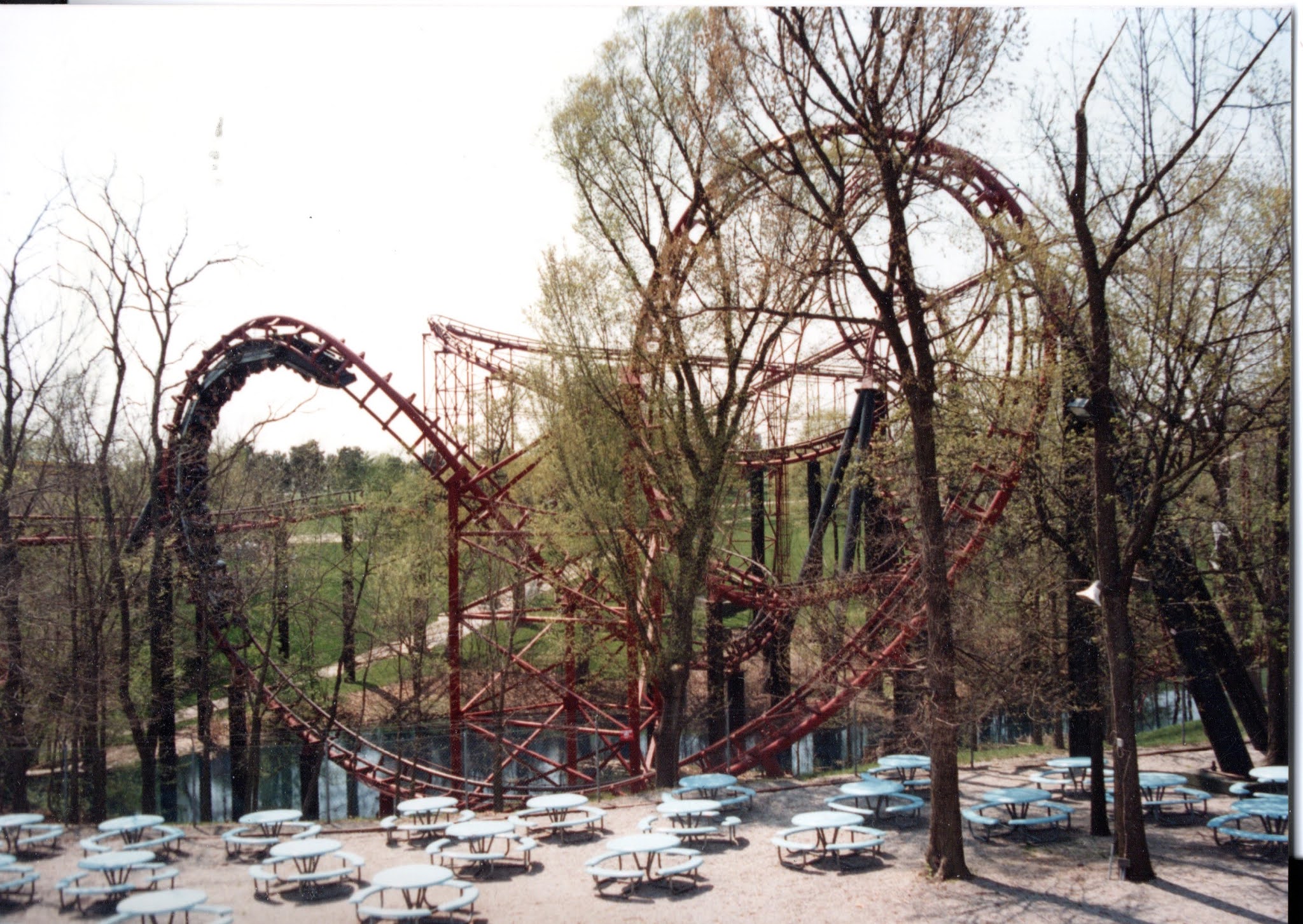
A few months ago I wrote a blog following the brief but important history of Schwarzkopf at Worlds of Fun. As my friends can attest I love to look at how things are interconnected, and no company is more interconnected at Worlds of Fun, or any theme park or amusement park than Arrow Development/Arrow Dynamics. The Arrow heritage has, at least in some small way, touched almost every ride at the park. And it wasn’t started with that intent at all.
Karl Bacon and Ed Morgan. Photo from Roller Coasters, Flumes and Flying Saucers by Robert Reynolds.
A very brief history of Arrow starts in 1946 when Karl Bacon, Ed Morgan, Angus “Andy” Anderson and Bill Hardiman opened a fabrication shop in Los Angeles, California. There wasn’t any original intent to build amusement park rides, and they almost became a footnote in history if it wasn’t for Walt Disney who happened to like one of the antique cars being built by Arrow at the time. Similar cars were later used as the original twelve cars for Mr. Toad’s Wild Ride, and Walt Disney would go on to hire Arrow to built almost all of Disneyland’s original attractions. In addition to Mr. Toad, Arrow would also build: Dumbo the Flying Elephant, Snow White’s Adventure, Mad Tea Party, and the Matterhorn Bobsleds just to name a few. Karl and Ed went from two small time steel fabricators to becoming the one-stop shop for the amusement-park world by simply having new ideas and the fortitude (and financial backing) to see them through.
A postcard of Shoot-the-Chutes at Electric Park in Kansas City. Postcard from author's private collection.
Another view of Shoot-the-Chutes at Electric Park Kansas City. Both postcards are from our private collection.
Many of the Arrow concepts weren’t new, but instead updates on very old amusement park attractions. Case in point, the Shoot-the-Chutes ride, a ride that was popular at the turn of the 20th century for taking guests, seated in a flat bottom boat, plunging down a drop and into a large lake of water below. Arrow would update this clunky classic and create something new: the log flume. Arrow’s first log-flume foray was in 1963 at Six Flags Over Texas with El Aserradero. They also used a similar concept on the Disneyland originals It’s a Small World and Pirates of the Caribbean. When Viking Voyager opened with Worlds of Fun in 1973 there was virtually nothing original about it, except for its unique Viking Dragon head boats.
An original Arrow advertisement for it's various flume ride vehicles, one of which is the unique Viking Boat design from Viking Voyager. Thanks to Adam Yerdon for allowing us to use this.
El Aserradero at Six Flags over Texas. Photo by Jeff Mast.
Viking Voyager at Worlds of Fun, photo by Jeff Mast.
In 1957 Arrow built the Midget Autopia ride for Disneyland, and again it wasn’t the first drive-yourself ride in the country; the first was almost as old as the car itself, dating back to the 1920’s. Arrow would once again take an old concept and make it new, and introduce its own version of this classic car ride, but this time with a center rail. Arrow called this simple new revolution the “guide-limited automobile”. Whatever you call it though this small change would make the ride safer, and easier to operate and the concept spread like wildfire. Arrow would go on to introduce its French-styled taxi cars, at Astroworld in 1968 called Le Taxi, Kings Island would follow in 1972 with Les Taxis; Worlds of Fun was already late to the party when it opened Le Taxi Tour in 1973.
It looks a lot like Le Taxi Tour, but not only is this ride no longer in operation but neither is it's entire park. This was Le Taxi at Astroworld in Houston, Tx. The entire park closed in 2005. Photo by Jeff Mast.
This one IS Le Taxi Tour. Photo by Jeff Mast.
There really was nothing original about Worlds of Fun’s old Arrow rides. However, what hasn’t been mentioned is that while at the time Voyager and Taxis were one of many in operation, today this is no longer the case. Astroworld no longer exists, and the Arrow French Taxi cars, while common in the 1970’s, are rare today. The same could be said for Arrow flumes which are falling victim to newer and flasher land-tenants as the years progress by. Voyager and Le Taxi Tour have become important not because they were landmarks at the time they opened, but instead because they continue to operate when so many of their brothers no longer do. The survivors are the legacy.
Concept art for Screamroller, which is artist's rendition of the original Corkscrew. Photo from Worlds of Fun's collection.
Screamroller when it first opened with it's all white color scheme. Pay attention to the supports over the actual corkscrew elements, they were changed between the original corkscrew and the copies. Postcard from the author's private collection.
Worlds of Fun wouldn’t stay in the background of Arrow history. Arrow would take its revolutionary tubular steel track it created for Matterhorn Bobsleds and build the world’s first modern coaster to take riders upside down, Corkscrew. The first corkscrew-model opened at Knott’s Berry Farm in 1975, and less than a year later Worlds of Fun would open the fifth copy of the corkscrew-model, on April 10, 1976. Dubbing their version as Screamroller, it was the first coaster in Missouri, to take riders upside down. The second inverting coaster in Missouri was Worlds of Fun’s own Orient Express and Six Flags Over Mid-America opened the third in 1981.
Loch Ness Monster under construction at Busch Gardens Williamsburg. Photo from Worlds of Fun's collection.
A few years later the second and last coaster actually built with interlocking loops was under construction at Worlds of Fun. Photo from the Worlds of Fun Collection.
Worlds of Fun opted for a custom-designed thriller a few years later when it unleashed Arrow’s tour de force at the time, the Orient Express on April 4, 1980. Orient Express was never the biggest, or the fastest, or the loopiest, but it would follow tried-and-true park tradition and certainly be the best. Loch Ness Monster which had opened at Busch Gardens Williamsburg in 1978 introduced the world to the interlocking loops, and Express would continue on that same legacy. Express would also build on the Arrow legacy though by introducing the first coaster element outside of the corkscrew and vertical loop, with the Kamikaze Kurve; or as it is better known the boomerang-element. Express would operate for 23 years at the park, and would accomplish a true amusement park feat of going out just as popular as it went in. The ride never had to languish and slowly fade away, and that in itself made it memorable.
Shockwave, at Six Flags Great America (now defunct) had seven inversions one of which was a boomerang very similar to that on Orient Express. Photo by Jeff Mast.
A near identical view of the original boomerang (Kamikaze Kurve) on Orient Express. From the Worlds of Fun Collection.
Viper at Six Flags Magic Mountain which opened in 1990 also has seven inversions but is still in operation. Photo by Jeff Mast.
Orient Express wouldn’t be the end to Arrow entanglements at Worlds of Fun, and only a few years later, most likely building on the success of Express, Arrow would again partner with Worlds of Fun on a new project. This time a concept was conceived during the short-lived merger of Arrow with German ride manufacturer Huss Rides. Arrow Huss together in 1983 came up with the idea to modify an existing Arrow coaster into something that had only been accomplished in Japan at this point, a coaster ridden not sitting, but standing up instead. They began the transition process for two Arrow coasters, Screamroller at Worlds of Fun, and River King Mine Train at Six Flags Over Mid-America near St. Louis. Sceamroller would open first, May 31, 1983, this time re-named to Extremeroller or E.X.T. for short. Railblazer, the re-named stand up version of River King Mine Train would open in 1984.
Railblazer would open at Six Flags Mid-America in 1984. Railblazer was the second track for the existing River King Mine Train that still operates at Six Flags St. Louis to this day. Postcard from the author's private collection.
Extremroller was first though, and opened May 31, 1983 as the country's first stand-up coaster. Postcard from the author's private collection.
Probably one of the most commonly repeated urban legends with Worlds of Fun comes from this very coaster. First the true story: Extremeroller was re-converted to a sit down in June 1984 due to stress on the lift chain, as with the significant change in the center of gravity it applied a significant increase in stress on the ride-structure. In July of 1984, a Railblazer rider was thrown from the car and died from her injuries. The accident occurred one month after Extremeroller had been re-converted to a sit-down experience. Railblazer also lacked one of the seatbelts that crossed the body that Extremeroller had, which means this type of accident may not have even been possible on Extremeroller. The fact is though that no life-threatening accident ever was to occur on the short lived stand-up Extremeroller. But the pervasive urban legend incorrectly attributes the Six Flags accident to Worlds of Fun. Extremeroller would operate as a sit down coaster until the 1988 season when it was removed and sold, and then shortly thereafter replaced by Timber Wolf. In its brief 12 year run at Worlds of Fun no one was ever killed in the operation of Screamroller or Extremeroller.
Python at Busch Gardens Tampa (now defunct), from around 1990. Photo by Jeff Mast.
Extremeroller from 1988, they look so similar because they were identical, both were Arrow Corkscrews. Photo by Jeff Mast.
So with Screamroller back to a sit down in 1984 that was the end of Arrow at Worlds of Fun correct? Yes and No. Arrow itself would go through a series of mergers, bankruptcies and re-organization which would see it re-introduced in the mid-1980’s not as Arrow Development, or Arrow Huss, but Arrow Dynamics.
Vortex opened at Kings Island in 1987, it was removed after the 2019 season. Photo by Jeff Mast.
And the original, Orient Express. From the Worlds of Fun collection.
Arrow Dynamics would go on to continue building its progressively loopier, and taller coasters, Vortex at Kings Island (actually based off Orient Express in design), Shockwave at Six Flags Great America, Great American Scream Magic at Six Flags Great Adventure, and Viper at Six Flags Magic Mountain just to name a few. In 1989 there was something new on the horizon for Arrow. Arrow designer Ron Toomer’s newest inspiration came to a park in Ohio called Cedar Point and would launch its climb to be the “roller coaster capital of the world”. Magnum-XL 200, a coaster with no loops, but instead built for speed and for height became the first coaster to drop riders 200 feet down. It was even given a new definition: the hyper coaster. Magnum was a hit out of the box.
Park World August 1990 Advertisement
At-The-Park January/February 1990 advertisement
Arrow would continue to produce coasters and rides following Magnum, some in the “breaking the mold” style of the great Arrow rides that came before it, the first 4th-dimension coaster at Six Flags Magic Mountain comes to mind. There would be still others that would be truly unique, requiring time and tweaking to make into a masterpiece, the 1991 Steel Phantom which became Phantom’s Revenge at Kennywood. In 2001 is a great example. Many though would be just following the same rutted road that Arrow had already tread for decades. And that was the problem. Arrow didn’t innovate as it should have, and when another company did, and produced smooth coasters that lacked the abrupt, head-pounding transitions that were the Achilles-heel of all Arrow coasters, that was the death knell of Arrow.
X2 at Six Flags Magic Mountain was a nightmare for both the park and Arrow. It is still in operation at Six Flags Magic Mountain. Photo by Jeff Mast.
A view of X2 from the parking lot at Magic Mountain. Photo by Jeff Mast.
Arrow would declare a final bankruptcy in 2001, and its assets would be bought by another amusement park company, S&S Power. S&S is famous for its own unique thrill rides, shot towers, and air launch coasters, like Detonator at Worlds of Fun and Powder Keg at Silver Dollar City. Today, S&S continues on the tradition of Arrow with its 4th-dimension coaster and their popular newer, yet more compact version, the 4D Free Spin. Nearby Adventureland in Des Moines, IA. is opening Dragon Slayer for 2021 which is the most recent 4D Free Spin model installed in the United States.
From Media Preview of Mamba, Paula and Dana Morgan in the front row with Laura Keller (wife of General Manager Dan Keller) and Steve Okomoto in the second row. Photo from Roller Coasters, Flumes and Flying Saucers. Also notice the lack of gates on the queue lines behind them.
Another photo from the same day, of the exact same train, coming in for the final turn over the station plaza. You can see Dana and Paula Morgan in the front of the 2nd car, with Daniel Keller in the front row of the 1st car. Photo by Jeff Mast.
There is also a great deal of Arrow legacy left in two coasters at Worlds of Fun. If you will recall one of the founders of Arrow Development was Ed Morgan. Ed had a son named Dana, who served as President of Arrow Huss for a short period in the 1980’s before he went on to form his own company Morgan Manufacturing. Cedar Fair, wanting to clone the success of Magnum at their other parks across the country turned to Morgan instead of Arrow to build hyper coasters inspired by Magnum. With help from former-Arrow Dynamics designer Steve Okamato, Morgan created Wild Thing at Valleyfair, Steel Force at Dorney Park, and Mamba at Worlds of Fun. Although Mamba is not an Arrow by name, it is a worthy successor of the great Arrow legacy.
Mamba is on the left, Magnum is on the right. The familiar traits are undeniable.
The backside of the same collectible cards.
The other coaster is Boomerang. If Mamba keeps alive everything that was great about Arrow, Boomerang… well it tries. Vekoma, which started its relationship with Arrow as their international distributor in the late-1970’s started producing several varieties of “off the shelf” Arrow-like coasters. These coasters were intended for smaller parks, ones that could not afford a custom Arrow. Vekoma would also be used prolifically by larger parks to help beef up their coaster line up during the coaster-wars of 1990’s and early-2000’s. There was their Suspended Looping Coaster (SLC), the less-common Invertigo model, and then there was the original, the Boomerang. By itself, Boomerang offers a decent thrill, but has tainted its reputation simply by being repeated, over, and over, and over again, 55 times to date. That’s 55 different installations of the EXACT SAME ride, at different parks across the world. And they operate and ride just like the old Arrows. In fact, the ride is so similar to the old Arrows that a boomerang train, and say a train from Orient Express could swap places, and still operate on the opposite coaster with very little modification being required.
Boomerang at Worlds of Fun opened in 2000. Photo by Jeff Mast.
What is fascinating about Vekoma though is that through all the years that Vekoma was spinning out Boomerangs and SLC’s they never changed the formula. They in all honesty got a little bit of a bad rep among coaster enthusiasts for trudging the same old road and producing the same old rough coasters, that is until recently. Recently, Vekoma has changed, drastically. Their new coasters seem far removed from the old Arrows, smooth, but yet still Arrow-like. In the past handful of years Vekoma has changed its image, and may yet be the new upcoming coaster manufacturer for the future. I’ve often wondered what would have happened if Arrow had figured out how to make their ride experiences smooth, but still create coasters with that unique, intense Arrow identity. Maybe they have. Maybe the legacy of Arrow will continue, and who knows maybe its not done at Worlds of Fun either. Only time will tell.
Abyssus at Energylandia in Poland testing in early 2021. Pay attention to the boomerang element! The legacy of Orient Express continues to live on!
The idea for this blog originated after watching the ACE Legacy of Arrow documentary. It is absolutely worth a watch and covers Arrow history very succinctly. It just doesn't mention Orient Express. :)
Special Thanks to Todd Swetnam, Nicholas Laschkewitsch and Adam Yerdon for Proofreading this story.
Twenty years ago, when I was much younger, and had no gray hair, I started an organization for folks that had met on www.worldsoffun.org called WOFFA. Among the several people I met and made friends with was a guy named Michael Parsons. A few years younger than me he seemed to remember a lot of aspects of Worlds of Fun that quite frankly, I just couldn't remember, one of those was the Aerodrome. Now before I get into the Aerodrome, and what it was, and where it was, one other point remains. Michael had an idea for several years to re-create photos of the Aerodrome and Barnstormer, or more a "before and after" of what the areas look like today.
Last year (2018) Mike did an awesome job shooting before and after photos of the Aerodrome during Haunt. Funny enough Mike is "the friend" in the Haunt Review if you have read that. I thought the photos were fabulous and I thought we should do more than just share them on Facebook, so I decided to write a blog about it which you are now reading. (and man the guy that said I was too wordy was right...)
Aerodrome, which was Worlds of Fun's fourth large land expansion (following The Forum, Screamroller, and the 1977 "A new attraction in every world" expansions), was a 3.5 acres expansion that we today know as Planet Snoopy. It was introduced for the 1978 season, and unlike today where it is known as a kid's section, Aerodrome was decidedly not just for kids, and included one of Worlds of Fun's probably most thrilling rides up to that point, The Barnstormer. At a little over a 100 feet tall, it was not only the tallest ride in the park up to that point, but probably offered the biggest thrill in the park too as once aboard the planes would dive up to 45 feet down which circling the central hub, or at least they did when it first opened. Barnstormer was quite ahead of its time, powered entirely by hydraulics, it was infamous for its July 1978 crash that literally sprayed hydraulic fluid halfway across the park, and put a stop to its more thrilling aerial aerobatics. The problems with Barnstormer were many, it wouldn't operate in high winds either (which might sound familiar to other CURRENT Worlds of Fun ride). To make to fine a point Barnstormer was one of only three "Barnstormer" rides produced by Bradley & Kaye, the first being at Old Chicago, the third and by in large most successful installation was at the also defunct Opryland which operated until the park closed for good in 1997. Barnstormer at Worlds of Fun wouldn't last near as long, and was finally removed from the park in June 1983, to be replaced the next year by Octopus which had been not only moved and re-painted, but also renamed to Tailspinner.
Barnstormer wasn't all that when it came to the Aerodrome either though, Aerodrome boasted a new theater, the Flying Circus Theater (which became the Bear County Museum, and is now roughly where the Snoopy Boutique is today), which was home to Dolores Hadley's Marionette show in the daytime and a 1970's style disco at night. Lunch could be found at the tall flight tower up the hill, known as Lucky Lindy's Lunch Counter which would live on into Pandamonium, and then become an employee break area, and the finally serve as the location for House on Boo Hill before it was finally demolished. (after the 2015 season). In fact, what made Mike's before and after shots so hard was the very lack of structures that have remained the same over the last forty years. So few that there are only a handful. First, Red Baron is not only the same location but the same ride that it was forty years ago and second, the Barnstormer's old pump house still remains and is most likely now only used for storage, but is painted to appear as a Peanut's Schoolhouse. The last two are really of almost no use when it comes to recreation shots, are the Planet Snoopy Bathroom (which to this day retains its original "airplane hanger" appearance) and the Family Care Center, which opened originally as Great Waldo's Crankshaft Prop Shop. So let's take a look at the before and after and of course, it will be far more fun to have something to look at right?
As mentioned previously, Red Baron, with all the variety of name changes its been through hasn't moved since it was relocated to the Aerodrome in 1978 (it was added to Scandinavia in 1974), it is excepting for mechanical and structural updates, exactly the same ride. This is shot looking roughly the same direction, and its amazing that if you look its the same trees in the background, only much larger!
Here is the Barnstormer pump house I was referring to. It was built for Barnstormer and except for very minor theming detail has changed very little. It allows for an almost exact location marker for where Barnstormer was.
House on Boo Hill was the final use for the basic structure that was Lucky Lindy's Lunch Counter, it originally had a large tower on top which you can see in the photo below.
If you look in the background, Lucky Lindy's is the white tower in the background (left) with yellow trim.
Funny enough, a plane themed attraction (Beagle Brigade Airfield) sits in its place today.
These two are actually shot in opposite directions, but shows that Woodstock Gliders today is in roughly the same location as Barnstormer was. It is the first aeronautical-themed ride to share the same space in almost thirty-five years. After the removal of Barnstormer mid-season 1983, as I previously mentioned Octopus was moved to this location in 1984. Octopus was kicked out by the arrival of the Bearenstein Bear Family Tree in 1997, which was displaced in 2001 by Snoopy Bounce. Woodstock Gliders is currently in this location today and was added in 2016.
This is the view today looking in the same direction. I believe the same "stick" trees that are apparent in the first photo also appear in the second photo but in a much more mature state.
Last one and this is my favorite, since it features Sky Hi, the ride with the key to my heart. It appears that Detonator and Barnstormer appear to line up, but just an FYI Detonator was built at a much lower elevation than Barnstormer. (which is why it always appears so much shorter than Mamba, though it really is very close in overall height). The red barn in Americana is the exact same building that once housed the Ski Hi and its queue line. You can even see that at least one of the Ponderosa Pines have survived from the original photo forty years prior.